Comprehensive collection and Analysis of Source Parameters in the eastern Adria plate Region
Central Questions
– How can heterogeneous earthquake rupture mechanism catalogs from across the Adriatic region be effectively integrated to constrain the three-dimensional regional stress field and identify local variations in faulting styles related to tectonic settings?
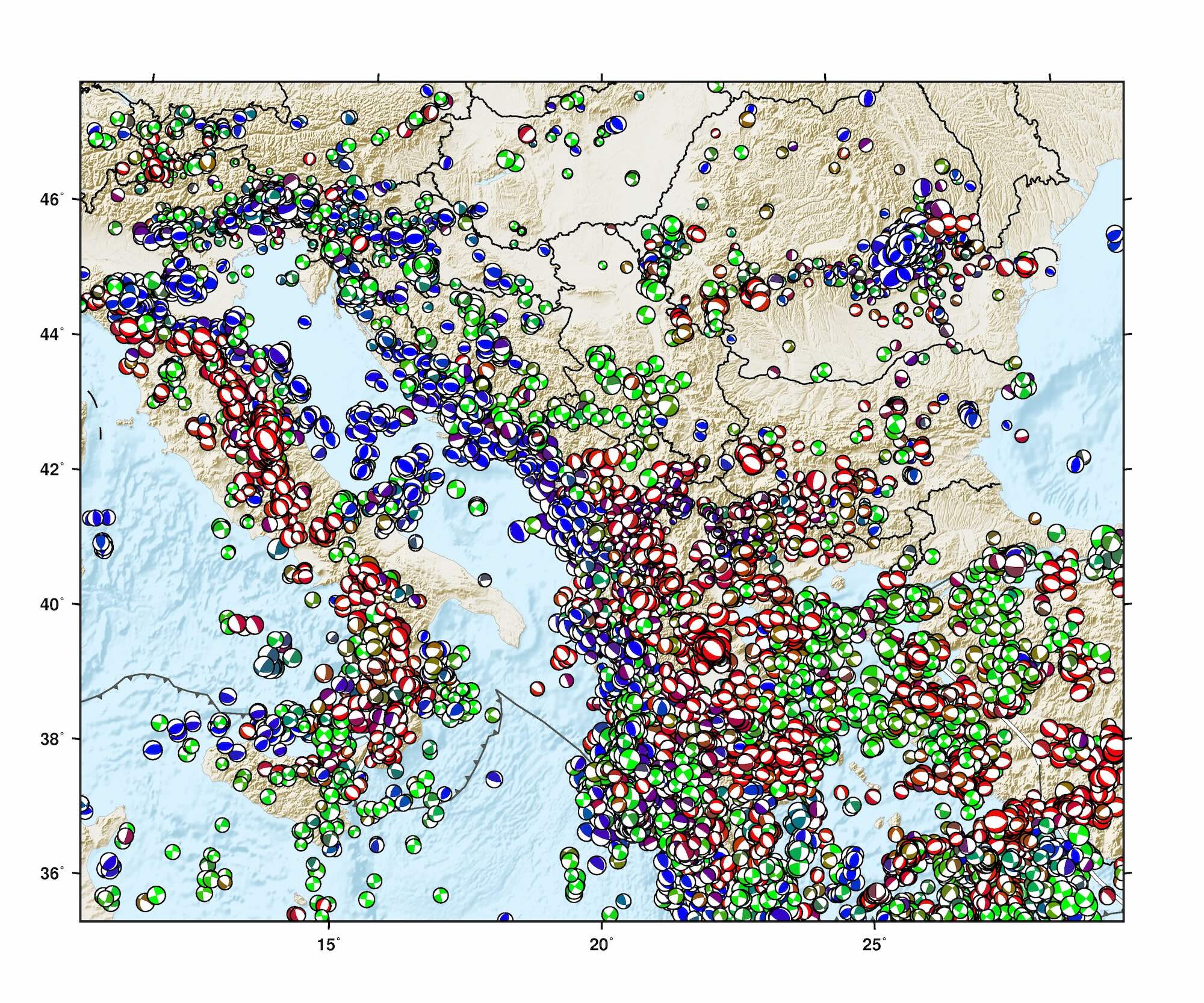
– What are the dominant faulting styles and stress orientations revealed by earthquake focal mechanisms from a multitude of available solutions across the Adriatic region?
– How does the spatial distribution of earthquake source mechanisms in the Adriatic region correlate with known active faults and geological structures?
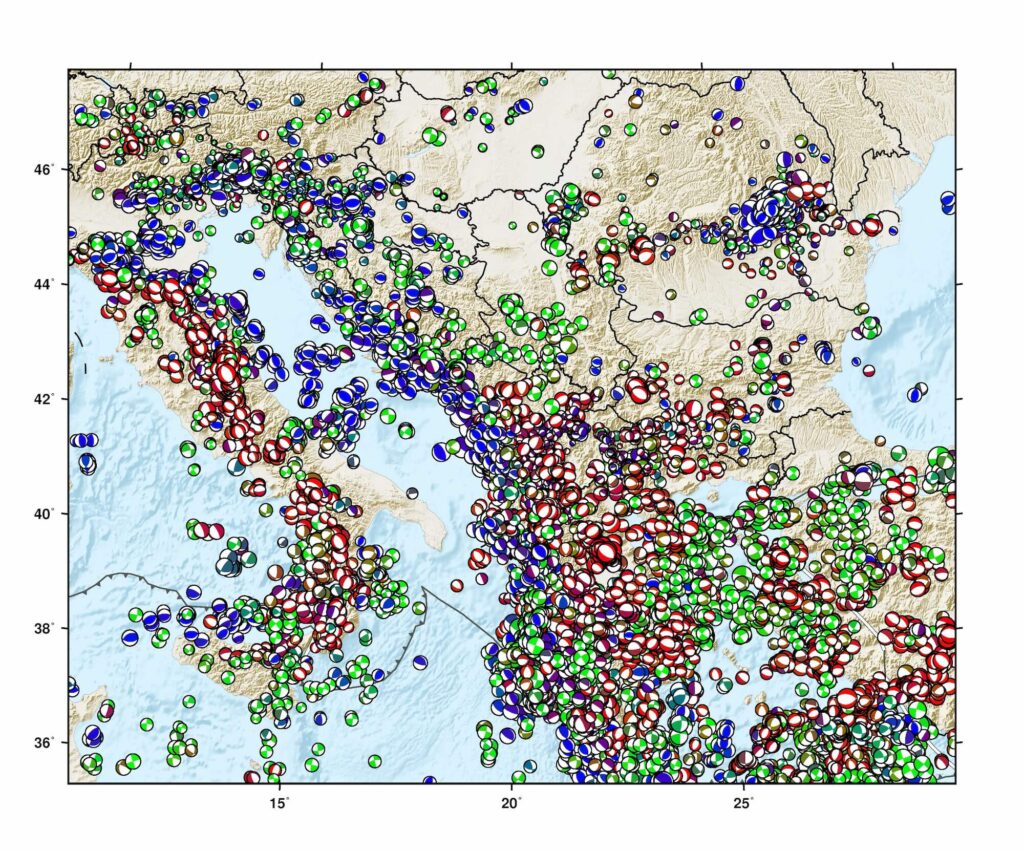
As a consequence of a complex tectonic history including plate convergence and subduction to multiple directions, the Adria region is known for a complex, diffuse seismicity. Different rupture processes and rupture styles occur, with seismicity posing a significant seismic hazard. Complex networks of active fault structures and heterogeneous stress conditions define the geological complexity of the Adriatic region, setting the stage for a challenging study area.
The complex societal and political history of the region led to a multitude of local institutions running small, regional networks, analyzing the data with different approaches and reporting earthquake analysis results and source parameters in different forms and to a different detail.
A timely recompilation of previous studies and seismic catalogs will be beneficial towards the analysis, discussion and interpretation of new data, new tectonic models, and towards a better understanding of future earthquakes.
With the recompilation and harmonization of the diverse available information, CASPAR aims at the generation of a homogeneous, openly distributed catalog for the whole Adria region. The catalog is built by collecting source parameters information from different sources, including literature research, databases scanning and close collaboration with seismological institutes in the study area.
The catalog will be used as input for several projects under the DEFORM initiative, as it delivers insights into the tectonics and stress regime of the region. Besides being open-access, it will also be open for future extension.
– Kagan angle (Kagan, 1991) and moment tensor based metrics (Cesca et al., 2014): When multiple focal mechanism solutions are available for the same earthquakes, these criteria can be used to assess the similarity of those solutions and select representative ones.
– Seiscloud (Cesca, 2020): Python-based open-source software for density-based clustering of seismicity. By using Seiscloud, we can facilitate the visualization of faulting mechanisms and anomalous solutions.
– Grond (Heimann et al., 2018): This Bayesian bootstrap-based inversion approach allows to compute moment tensors delivering uncertainties and parameters trade-offs. These features will help to recompute moment tensors if needed and decide if the new solutions are stable.
– Pyrocko (Heimann et al., 2017): It is an open source seismology software. Among its various applications, we will consider Seismosizer to compute synthetic seismograms when ambiguous solutions are given.