Image: © Anna Fröhlich
Investigation of the Kefalonia Transform Fault Zone using seismic wavefield analyses: seismicity, Amphibious array measurements, local gradients, and ROtationS
Central Questions
– What is the detailed 3D fault geometry and segmentation of the KTFZ, and how is deformation partitioned between seismic and aseismic processes?
– Where is the exact edge of the underlying subducting Ionian slab located, and how does it affect regional geodynamics?
– What is the precise local shear-wave velocity structure and anisotropic pattern in the crust and upper mantle?
– How do fault-scale dynamics and stress fields link to broader plate-scale drivers, and what are the implications for regional earthquake and tsunami hazards?
– The Kefalonia Transform Fault Zone (KTFZ) is one of the most seismically active fault zones in Europe, historically responsible for major destructive earthquakes (e.g., Mw 7.0 in 1953 and Mw 6.8 in 1983).
– Geodynamically, the KTFZ acts as a STEP fault, marking a critical transition zone between southern oceanic subduction and northern continental collision.
– Despite its high seismic risk, key structural features—such as the exact fault geometry, its segmentation, and the precise boundary/edge of the underlying Ionian slab—remain insufficiently resolved.
Overall Goal:
Gain new, high-resolution insights into the crustal deformation, geodynamic drivers, and structural properties of the KTFZ to improve physical earthquake and tsunami hazard assessments.
DEFORM Research Theme Alignment:
– KAROS will focus on fault scale processes (DEFORM research theme 2: seismic and aseismic behaviour of faults as well as characterization of plate boundaries and their deformation) using new methodologies for detailed seismicity and focal mechanism characterization.
– Innovative approaches to 3D seismic tomography and stress field characterization will provide the link to plate scale processes (DEFORM research theme 1: geodynamic drivers and plate configuration)
– The results of our amphibious experiments will provide important ingredients for physical earthquake and tsunami hazard assessment (DEFORM research theme 3).
Amphibious Passive Seismic Array (KAROS):
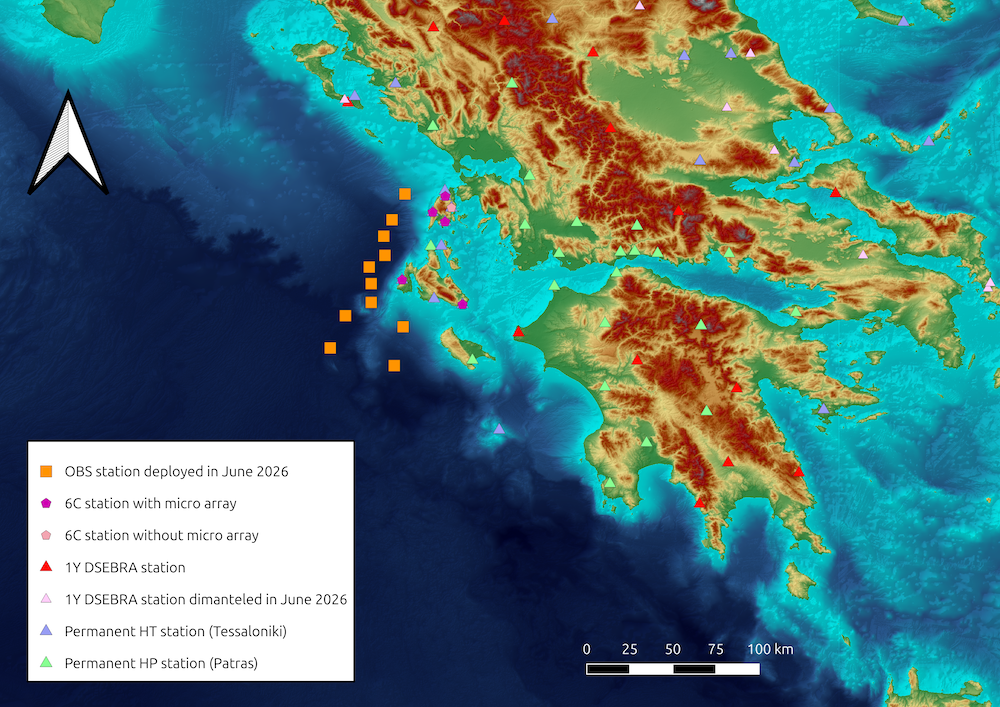
– Deployment of 15 Ocean Bottom Stations (OBS) to the West/South-West of the KTFZ.
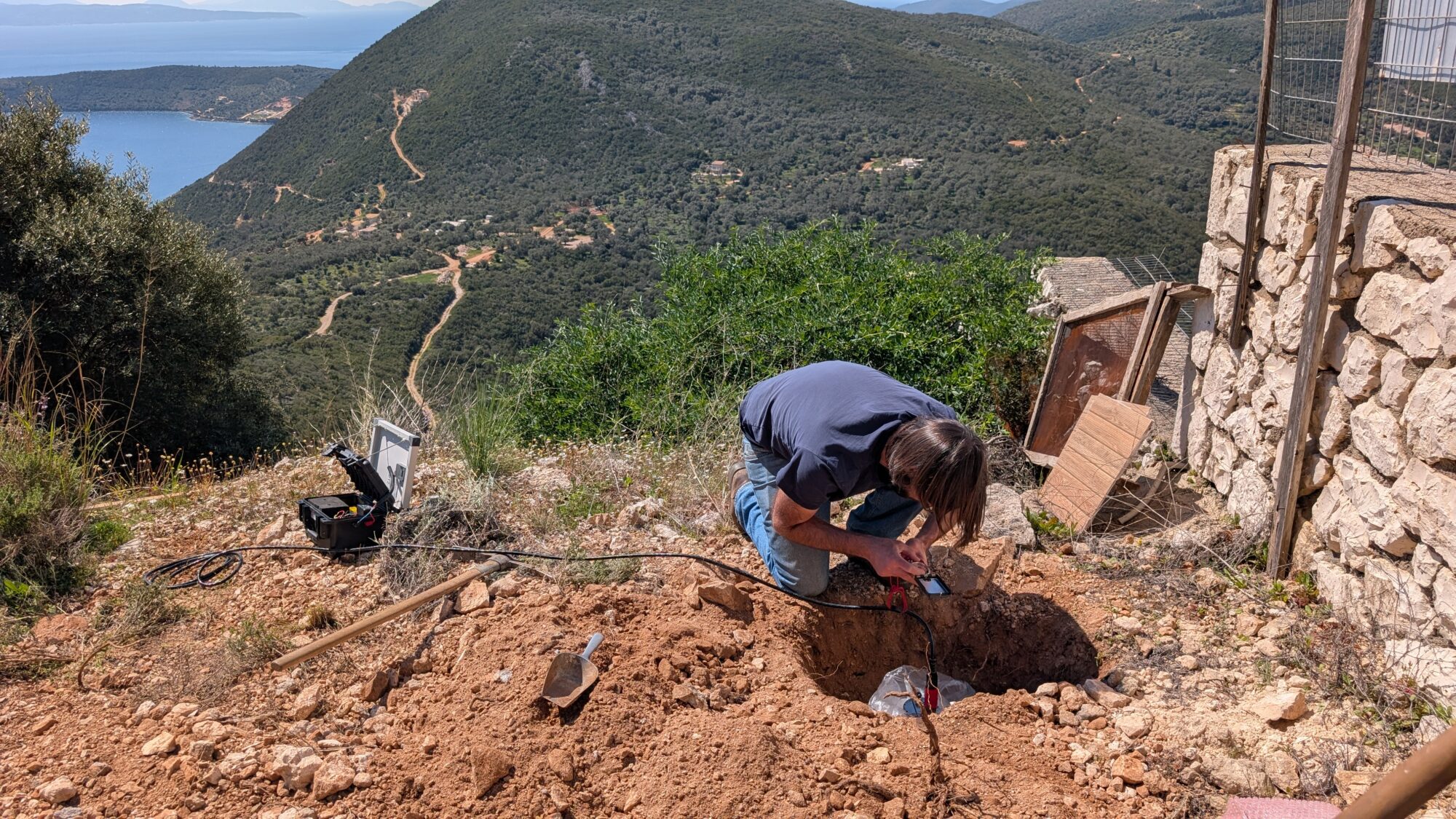
– Installation of 5 six-component (6C) stations and small-scale land arrays on Kefalonia and Lefkada Islands.
– Integration with existing AdriaArray (DSEBRA) onshore networks for enhanced spatial coverage.
Spatial Wavefield Gradient Analysis:
– Direct measurement and array-derived processing of spatial wavefield gradients using 6C observations.
– Application of advanced Eikonal and Helmholtz tomography to resolve local shear-wave velocity models and crustal/upper-mantle anisotropy.
Seismicity & Stress Field Characterization:
– High-precision earthquake relocation and focal mechanism determination across the expanded amphibious network.
– Innovative 3D seismic tomography to image sub-surface structures and infer regional stress patterns.