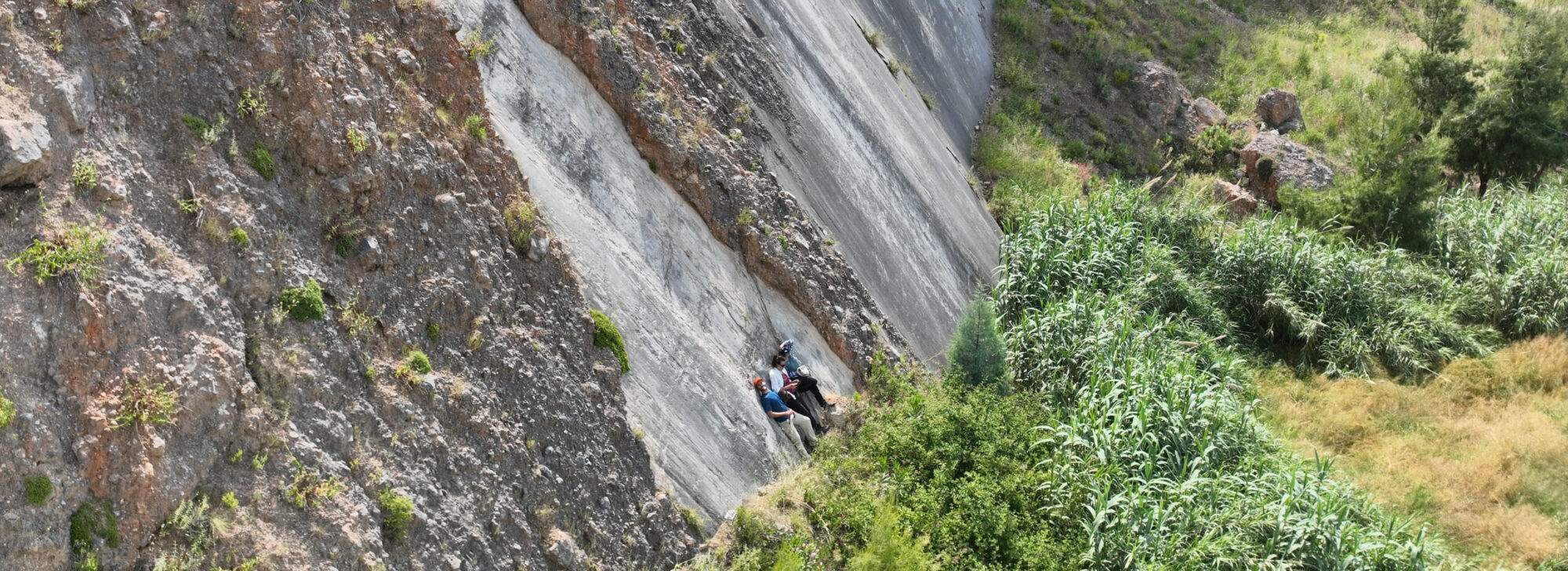
Image: Micene Fault © S Crosetto @ GFZ
Establishing a multi-disciplinary active tectonic framework at the transition between Adria collision and Aegean extension
Central Questions
– How are the western Balkans shaped by the interplay between plate boundary forces, collisional processes, trench retreat, body forces, and mantle convection?
– How does the transition from subduction to collision affect upper plate deformation and the kinematics of deformation and strain transfer to the Aegean system?
– What role does the North Anatolian Fault play in driving deformation?
The eastern central Mediterranean is a highly complex tectonic region where various tectonic processes interact over short spatial and temporal scales. The Adria plate plays a pivotal role in this region by colliding with the Dinarides to the north and subducting beneath the Hellenic trench to the south. Along-strike variations in subduction dynamics generate complex deformation in the upper plate, resulting in a rotational velocity field and diverse fault orientations with complex kinematics. These fault systems stretch from the Western Balkans to mainland Greece and the Peloponnese, with N-S, E-W, and NE-SW orientation. Despite numerous studies, the origin and distribution of the complex strain field, the way faults are distributed and oriented, and their evolution are debated. At the geodynamic scale, significant questions remain unresolved regarding the interplay between boundary and body forces, the role of mantle dynamics, and the mechanisms driving faulting and strain accumulation.
We aim to explore three main geodynamic models that have been proposed to explain the observed deformation patterns:
- Large-scale rotation of the Dinarides and western Greece induced by the differential motion of the subducting slab, resulting from the transition from collision to subduction. Such effects will be exacerbated by toroidal flow of the mantle around the slab edges.
- Gravitational Potential Energy (GPE) and extensional collapse, caused by the difference in GPE between the thickened crust in the Albanides–Hellenides highlands relative to the lower-lying Mediterranean seafloor.
- Westward propagation of the North Anatolian Fault. In this model, the extensional deformation results from a diffuse propagation of the NAF in mainland Greece, causing extensional deformation central Greece and connecting with the Kefalonia Transform Fault, which marks the Ocean-To-Continent transition of the subducting Adriatic lithosphere.
With this project, we want to develop a multi-disciplinary, integrated understanding of the seismotectonic regime along this diffuse plate boundary by using geologic, geodetic, and seismological data; in detail:
i) Structural and morphotectonic analysis, to define the faults’ kinematic evolution over space and time;
ii) InSAR time-series analysis, to create 3D surface deformation rate maps revealing the strain field;
iii) Seismotectonic analysis, to identify and characterise active faulting through seismicity analysis and earthquake focal mechanisms.
iv) Elastic block modelling, to quantify regional tectonic block kinematics and derive fault slip rates and the degree of interseismic coupling on major block-bounding faults.