
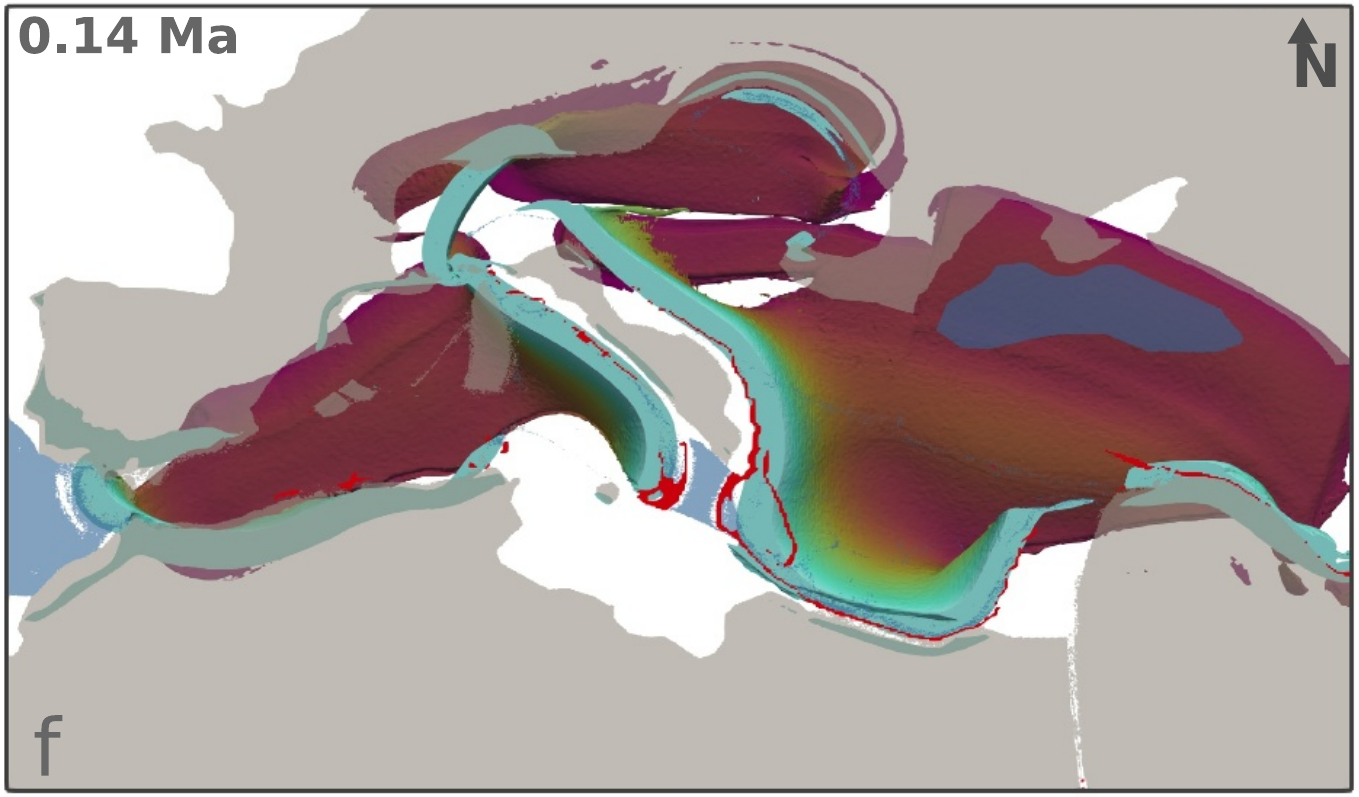
Image: © Schuler et al. 2025
Data2Model: Building the knowledge to convert observations to models
Central Questions
– How can we optimize the integration of geophysical data into physics-based geodynamic modelling?
– How does the stress state of the Adriatic lithosphere depend on geometry and rheology of the subducting slabs?
– How large are the uncertainties of model results caused by uncertainties in geometry and rheology of the lithosphere?
The Adriatic microplate is located between the Apennines, the Alps, the Dinarides, the Hellenides, and the Calabrian Arc. Seismic tomography, receiver functions, and seismic anisotropy paint a complicated and controversial picture of the subducting slabs of this plate. From a potential slab window beneath the Northern Appennines, to the absence of a slab beneath the Dinarides, and horizontal or vertical slab tearing beneath the Hellenides, many configurations seem possible. To account for such a diverse collection of scenarios, geodynamic modelling studies require tools which facilitate i) the joint interpretation of different datasets and observations and ii) the efficient creation of complex initial data-driven geometries which are based on the results of imaging studies. The rheology and stress state of the Adriatic lithosphere is as complex and controversial as its geometry. However, these uncertainties can be minimized when geodynamic models are utilized in an inversion framework which is supported by observables such as surface deformation, surface heat flow, and mantle anisotropy.
Data2Model aims at advancing the predictive capability of conventional exploratory studies (e.g. seismic tomographies) by integrating them in a workflow derived from physics-based geodynamic modelling. We will develop the infrastructure to seamlessly integrate geophysical, geodetic, geological and geomorphological data sets, interpret them and design data-driven geodynamic models around the Adriatic Sea.
Most importantly, building on this workflow, Data2Model also aims to develop the means to conduct geodynamic inversions to constrain the state of stress in the crust and lithosphere and to quantify the uncertainty and range of geometric and parameter variations. As a result, Data2Model will provide improved crustal stress fields suitable for earthquake rupture simulations
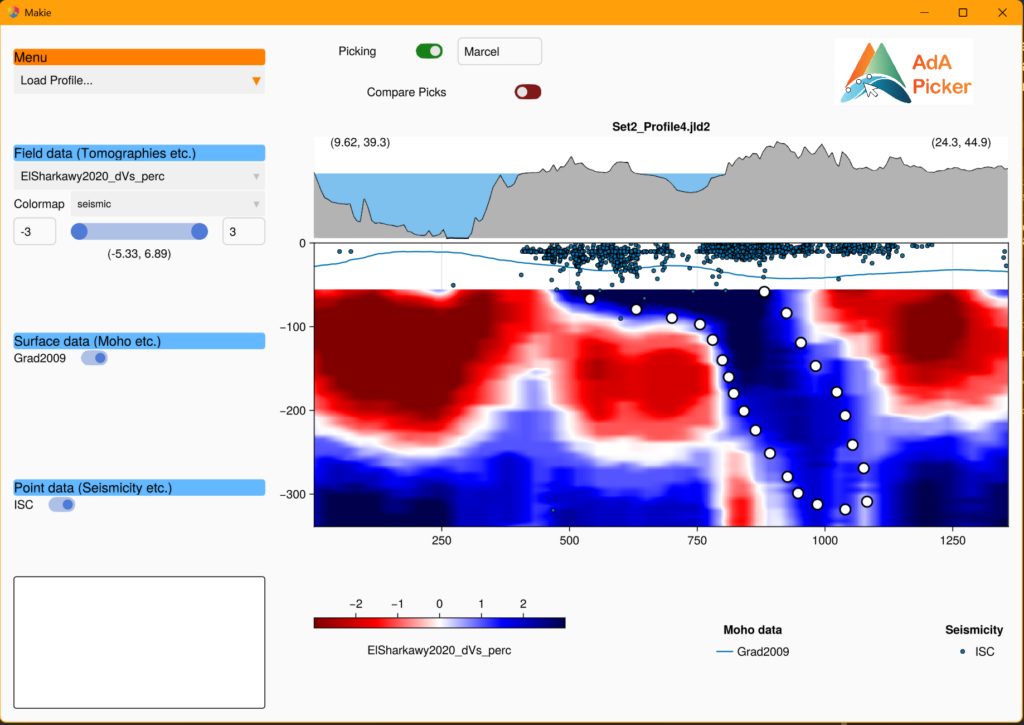
A central theme of Data2Model will be the further development of GeophysicalModelGenerator.jl, an open-source software package to jointly visualize and integrate different geophysical data sets. This will include a new graphical user interface which will allow users to pick subducting slabs on arbitrary seismic profiles and combine them into three-dimensional volumes which can directly be transferred into the initial geometry of geodynamic, numerical models.
Data2Model will use the finite-difference code LaMEM to conduct 3D geodynamic models of the Adriatic Sea. After a sufficient number of geodynamic models with various initial geometries and rheological structures have been created, surrogate models will be constructed for an efficient mapping of global sensitivities and uncertainties. The final step will involve a joint inversion for the dynamics surrounding the Adriatic microplate.