
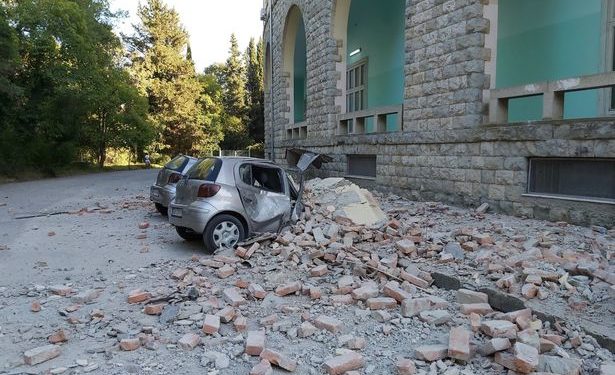
Image: Photo published by Orthodox Times in “Albanian Orthodox Church supports the earthquake victims” (22 September 2019);
photographer not specified.
CyberShake and SeisSol for physics-based fault-rupture and ground-motion simulations at the Eastern Margin of the Adriatic Plate using Supercomputing
Central Questions
What is the expected ground motion that potential earthquakes nucleated in the faults located at the Eastern Adriatic margin can generate?
What is the earthquake potential (largest magnitude) of the faults in the Albania and Northern Greece region?
Which are the populated centers that can experience the largest ground motions in case of an earthquake occurrence?
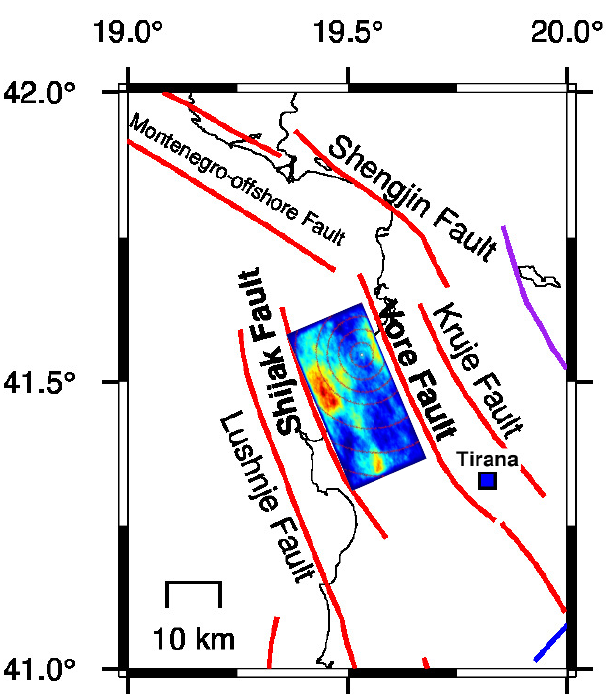
Large and destructive earthquakes have affected the eastern margin of the Adriatic region, e.g., the 2019 Mw 6.4 Dürres earthquake and the 1953 Mw 6.8 Ionian earthquake. Because we cannot predict such events using state-of-the-art scientific knowledge, we can instead use physical modeling of fault rupture and wave propagation to estimate the ground motion that similar or larger-magnitude earthquakes can generate in a region. For example, the Statewide California Earthquake Center (SCEC) has developed the CyberShake platform to generate seismic hazard models for California, yielding impactful results. For areas like the Eastern Adriatic margin, where estimated peak ground accelerations are among the highest on the continent according to the last European Probabilistic Seismic Hazard study in 2020, CyberShake can be a useful tool for complementing previous seismic hazard estimates with results from physical models that incorporate the region’s geological and geophysical knowledge.
We are working on modeling the physics of fault rupture and seismic wave propagation to estimate the ground motion that potential earthquakes could produce at the Earth’s surface, especially in the most densely populated cities of Albania and Northern Greece. Thousands of earthquake scenarios will be simulated with the CyberShake platform, which, with advice from CyberShake’s developer team at SCEC, will be prepared to run scenarios for this specific use case. Complementarily, we will run dynamic earthquake simulations with the SeisSol code, which will help us evaluate the probability of different scenarios. Synthetic seismograms and intensity variables will be generated by our simulations. Results will be validated by comparison with observations and Ground Motion Prediction Equations (GMPEs). We will prepare the information required to run a final Physics-based Probabilistic Seismic Hazard Analysis with CyberShake.
CyberShake is an HPC platform that can simulate thousands of earthquake scenarios. Scenario variability relies on stochastic slip models produced by the Graves and Pitarka (2010, 2016) rupture generator and on fault sources that are exhaustively explored to simulate all potential hypocentral locations. Kinematic fault ruptures are simulated using an input faulting model that provides the geometry and spatial distribution of sources. Ground motions are efficiently simulated by applying the reciprocity principle. Each simulation employs a surface impulse source polarized horizontally to compute the strain-tensor response of each fault surface. CyberShake uses the Anelastic Wave Propagation code to resolve the rupture-to-site wave traveling through a structural velocity model and to estimate the final synthetic time histories recorded at each observation site.