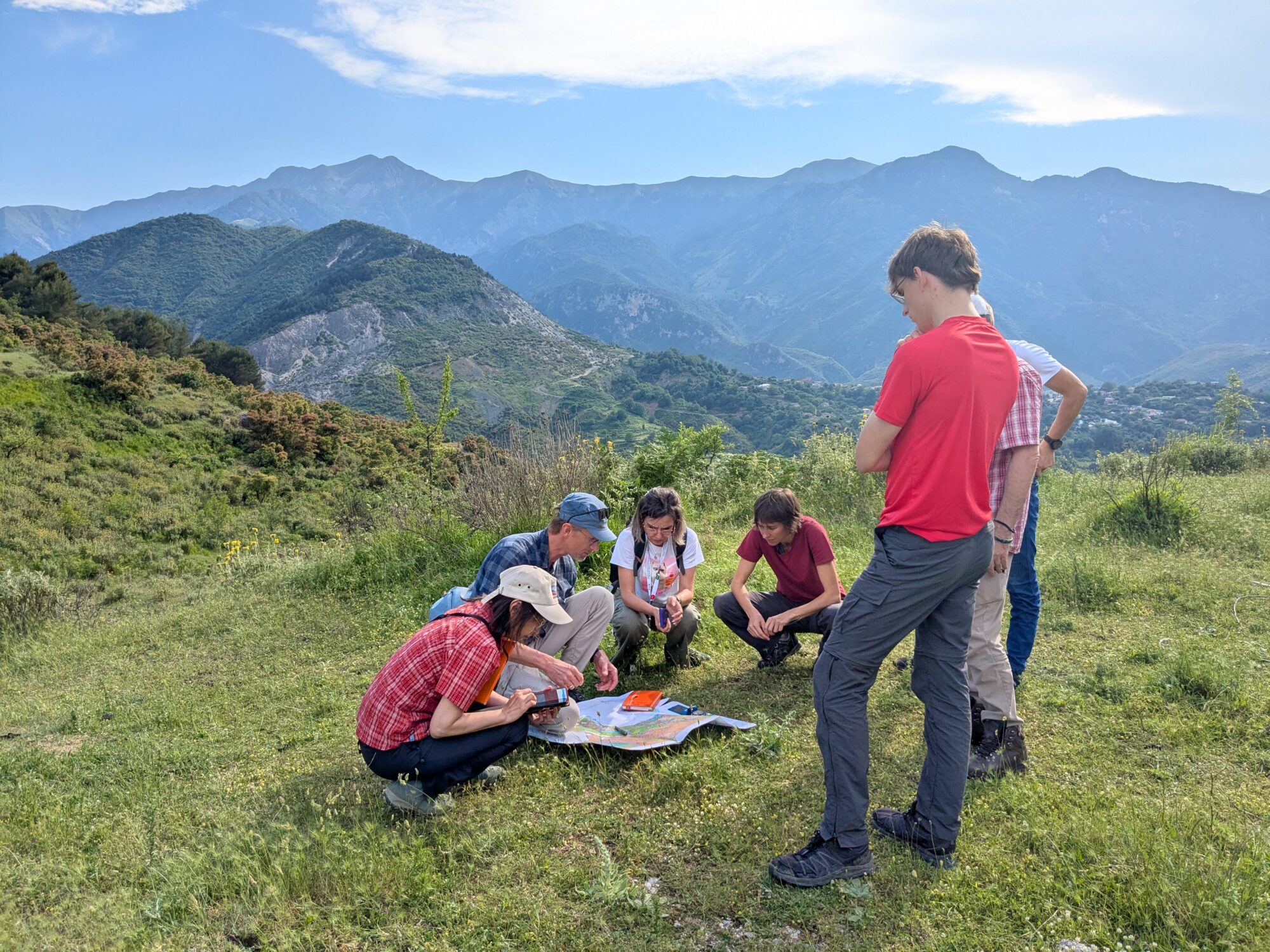
Image: Teams from DEFORM projects “SeismicTwister” and “Neogene-Quaternary” joining forces during fieldwork in Albania in May 2026, aiming for spatial overlap in their analyses. From left to right: Sumiko Tsukamoto, Kamil Ustaszewski, Ana Fociro, Sofia Kufner, Till Svara (student); partially obscured: Daniel Köhn, Oltjon Koleci (PhD student); not visible: Philipp Balling, Marah Kieckbusch (student), Eric Salomon.
Crustal deformation along the Dinarides-Hellenides Transition in 4D
Central Question
– How does the bending and rotation of a subducting lithospheric slab control 3D deformation and stress distribution in the Earth’s crust?
Deformation of Earth’s crust in convergent plate boundary zones is strongly influenced by deep lithospheric processes, including the bending and rotation of subducting slabs. These processes are thought to have been particularly pronounced in the Dinarides–Hellenides Transition Zone, where the Adriatic microplate converges with the western Balkans and where a previously subducted slab may have partially broken off. Understanding how crustal deformation is partitioned in response to these deep processes is essential for both tectonic research and seismic hazard assessment in the region.
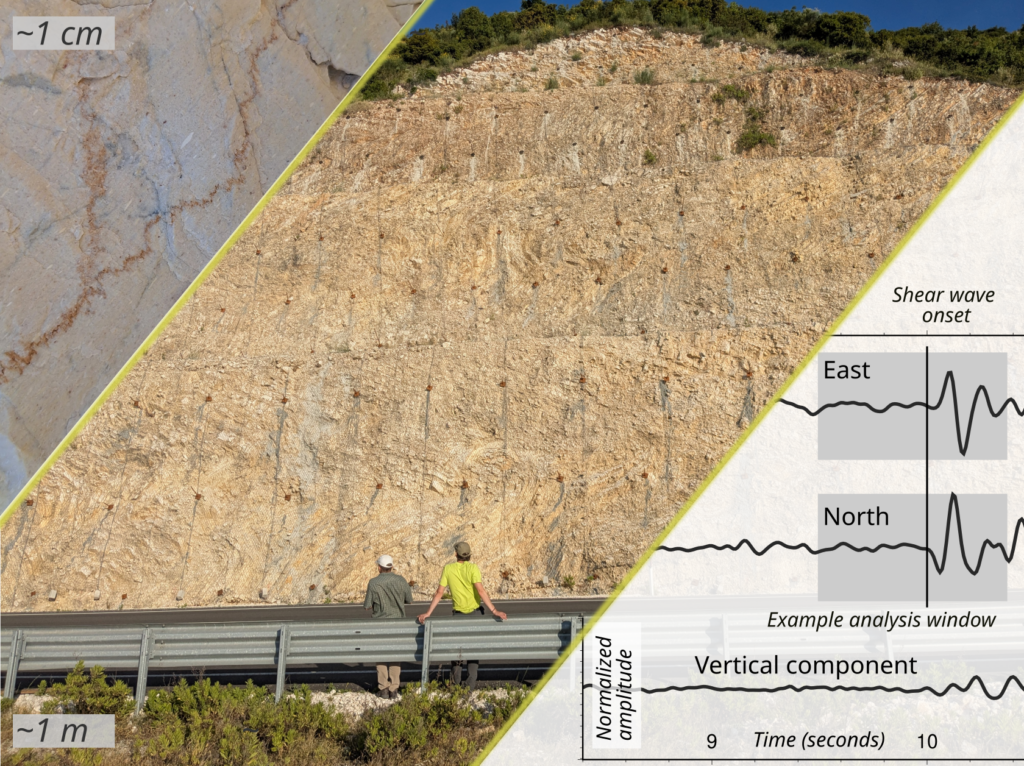
Understanding crustal deformation requires constraining the distribution and evolution of crustal stress. While fault-based approaches provide important insights into brittle failure and rupture-related stress regimes, they are less effective in capturing distributed or non-brittle deformation. This project therefore integrates seismological and geological approaches to enable a more complete, multi-scale understanding of crustal deformation.
We aim to:
(1) perform shear-wave splitting (SWS) analysis on seismic data recorded by the ANTICS seismic network to derive seismic anisotropy and extract constraints on the present-day crustal stress field from these results.
(2) conduct targeted geological fieldwork and apply the Stylolite Roughness Inversion Technique (SRIT) to rock samples in order to reconstruct paleo-stress orientations and magnitudes.
(3) integrate seismic anisotropy results into an inversion framework and incorporate constraints from geological stress indicators to derive the prevailing stress field.
Shear wave splitting analysis (SWS) uses the fact that shear waves split into two orthogonal polarized waves as they travel through an anisotropic medium. Measuring the delay time (dt) between these two quasi-shear waves as well as the polarization direction of the faster wave (phi) allows to derive information on the anisotropic properties of the medium the wave travelled through.
Stylolite Roughness Inversion Technique (SRIT) analysis: Stylolites are seam-like structures in rocks that represent dissolution surfaces where insoluble material accumulates during the process of pressure solution. Stylolites can be seen as ‘stress gauges’ and can be used as stress inversion tools.
Synthesis: To explain SWS measurements in terms of crustal stress, we will build on an inversion scheme implemented by Wookey (2012) and Kufner et al. (2023). Within this framework, the subsurface is discretized into several spatial and depth domains that are characterized by distinct elastic properties described by the elastic tensor. Constraints on the domains and elastic tensors will be derived from SRIT results and other available stress data. The inversion then seeks to determine the set of elastic tensors that most consistently explains the observed SWS.
Researchers
-
 Ana FociroPrincipal Investigator
 -
 Daniel KöhnPrincipal Investigator
 -
 Sofia KufnerPrincipal Investigator
-
 Hans Agurto-DetzelCollaborator
 -
 Andreas RietbrockCollaborator
 -
 Eric SalomonCollaborator