Image: from Kiraly et al. 2018
Plate deformation, slab gaps, and mantle flow along the eastern margin of the Adriatic Plate from joint inversion of surface waves and shear-wave splitting
Central Questions
How do slab gaps, slab tearing, and mantle flow influence lithospheric deformation and geohazards along the eastern Adriatic Plate margin?
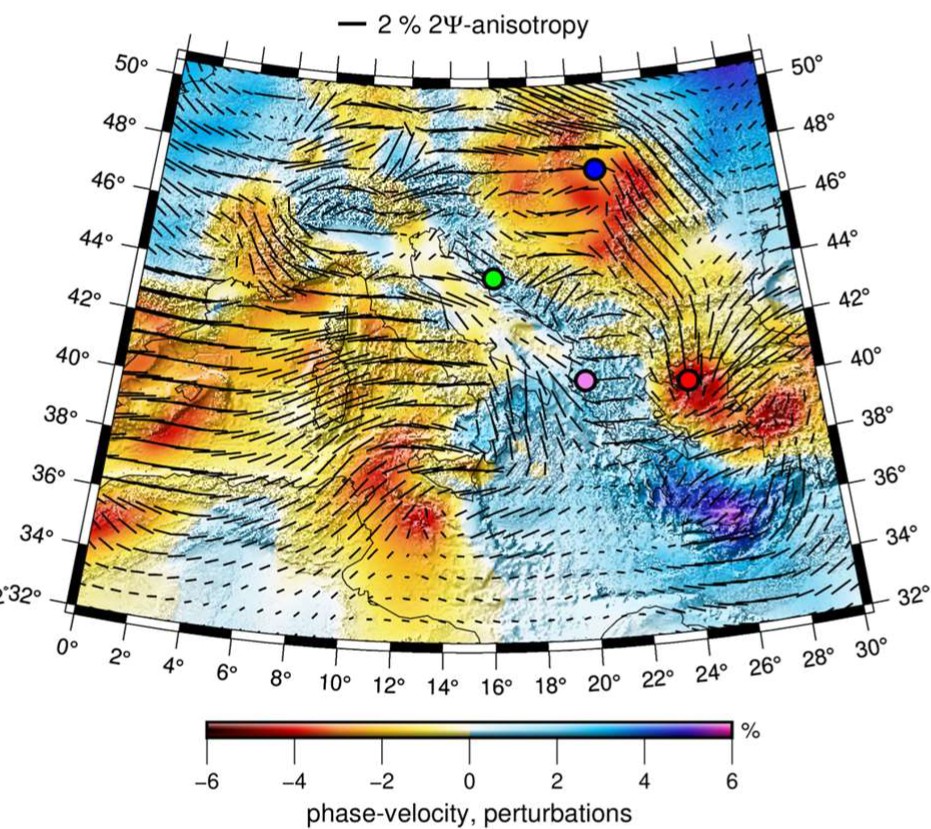
To identify the causes of geohazards along the eastern margin of the Adriatic Plate, it is essential to study geodynamic processes such as slab pull, mantle flow, and lithospheric deformation. The region is characterized by a transition from oceanic subduction in the southern Aegean to continental collision in the Hellenides and Dinarides. This transition involves several complex processes, including subduction, delamination of continental mantle lithosphere, lithospheric tearing (both horizontally and vertically), asthenospheric mantle flow, and crustal deformation, many of which remain poorly understood. To address this, we propose developing a three-dimensional azimuthally anisotropic shear-wave velocity model, by employing innovative joint inversion of shear-wave splitting and surface-wave phase velocity data. These two types of seismic observations, which have largely been analyzed independently in previous studies, will be integrated to systematically resolve lateral structural heterogeneities and azimuthal anisotropy within the crust, the mantle lithosphere and the asthenosphere.
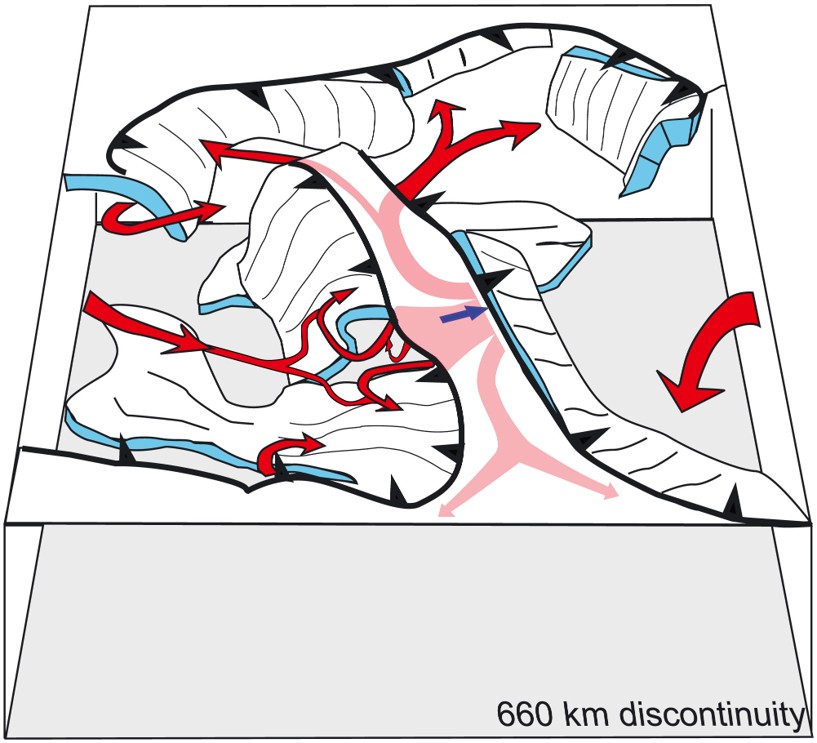
The project aims to determine how mantle flow, slab dynamics, and lithospheric deformation interact along the eastern margin of the Adriatic Plate. To achieve this, it will develop a high-resolution three-dimensional model of shear-wave velocity and azimuthal anisotropy by jointly inverting surface-wave dispersion and shear-wave splitting observations. Specific objectives are to (1) identify slab gaps, slab break-off, and horizontal or vertical slab tearing beneath the Dinarides and Hellenides; (2) distinguish between active mantle-flow-related anisotropy and frozen-in lithospheric deformation; (3) constrain the distribution of stress and deformation from the crust to the asthenosphere; (4) investigate whether past tectonic events, such as Miocene extension, are preserved in seismic anisotropy; and (5) determine how mantle flow patterns influence present-day lithospheric deformation and geohazards. The resulting model will provide key constraints for geodynamic models of the Adriatic collision-subduction system.
- Measure shear-wave splitting parameters (fast directions, delay times, splitting intensities) from teleseismic XKS phases to characterize seismic anisotropy.
- Measure Rayleigh and Love wave phase velocities from earthquake and ambient-noise data over a broad period range (3–250 s) to image crustal and mantle structure.
- Generate anisotropic phase-velocity maps and gridded shear-wave splitting datasets with rigorous quality control and resolution testing.
- Develop new forward-modeling tools for shear-wave splitting that account for lateral variations in anisotropy using Fresnel-zone averaging.
- Develop a stochastic joint inversion framework that simultaneously inverts surface-wave and shear-wave splitting observations for depth-dependent anisotropy.
- Construct a 3D azimuthally anisotropic shear-wave velocity model of the crust, lithosphere, and asthenosphere.
- Interpret the model geodynamically to identify mantle-flow patterns, slab gaps and tearing, and distinguish active from frozen-in deformation.