
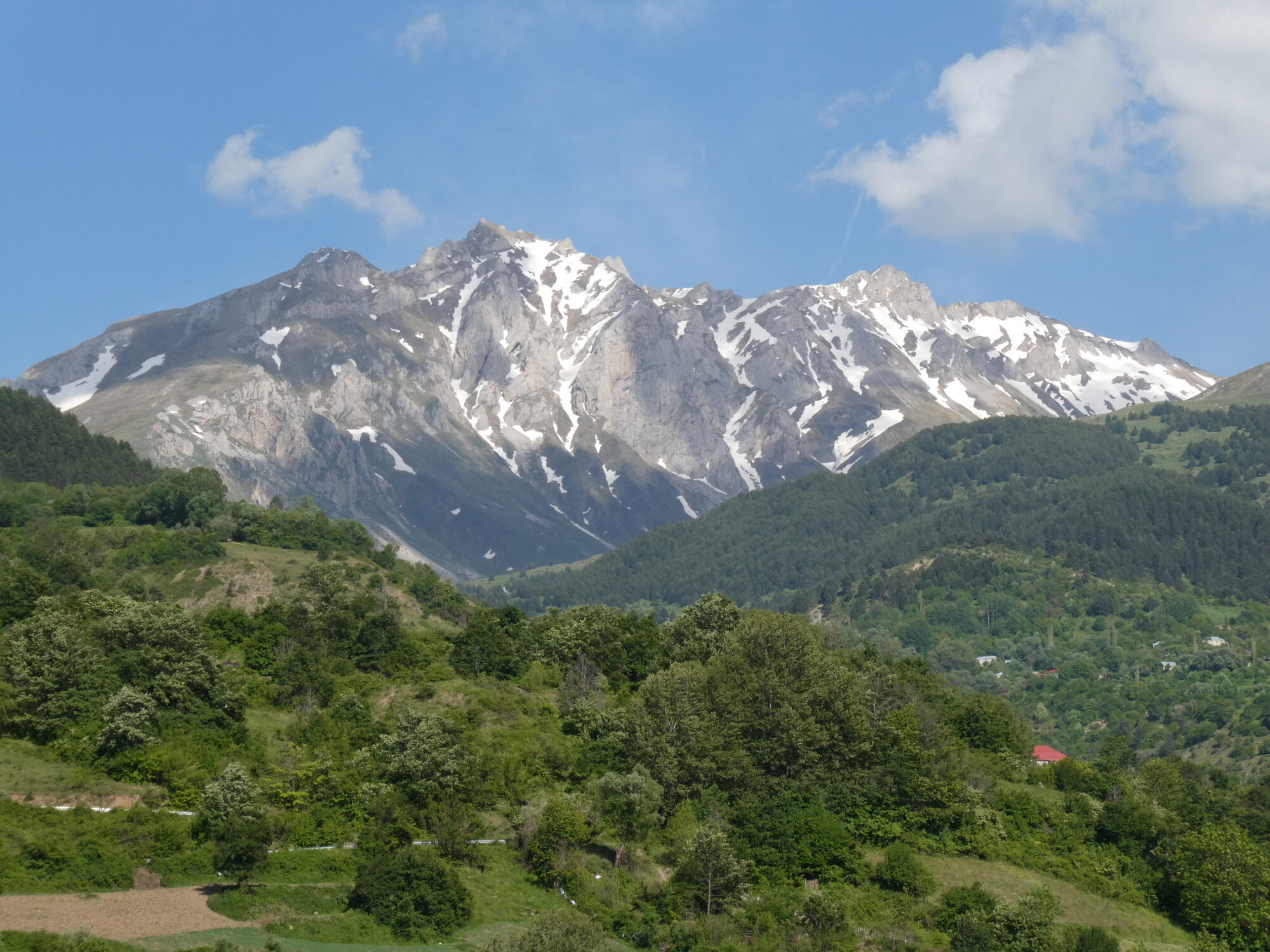
Image: the snow-capped massif containing Mount Korab (2764 m above sea level) in June 2026 and viewed towards east. The bright grey rock cliffs consist of Devonian limestones. © Kamil Ustaszewski
Constraining Neogene to Quaternary exhumation rates in contractional vs. extensional segments of the Dinarides-Hellenides transition using calcite/dolomite thermoluminescence thermochronology
Central Questions
– How did Neogene to Quaternary exhumation differ between contractional and extensional sectors of the Albanian Hellenides?
– How do carbonate thermoluminescence cooling ages compare between contractional and extensional tectonic segments in Albania?
– What exhumation rates can be derived from age-elevation profiles and structural constraints in these areas?
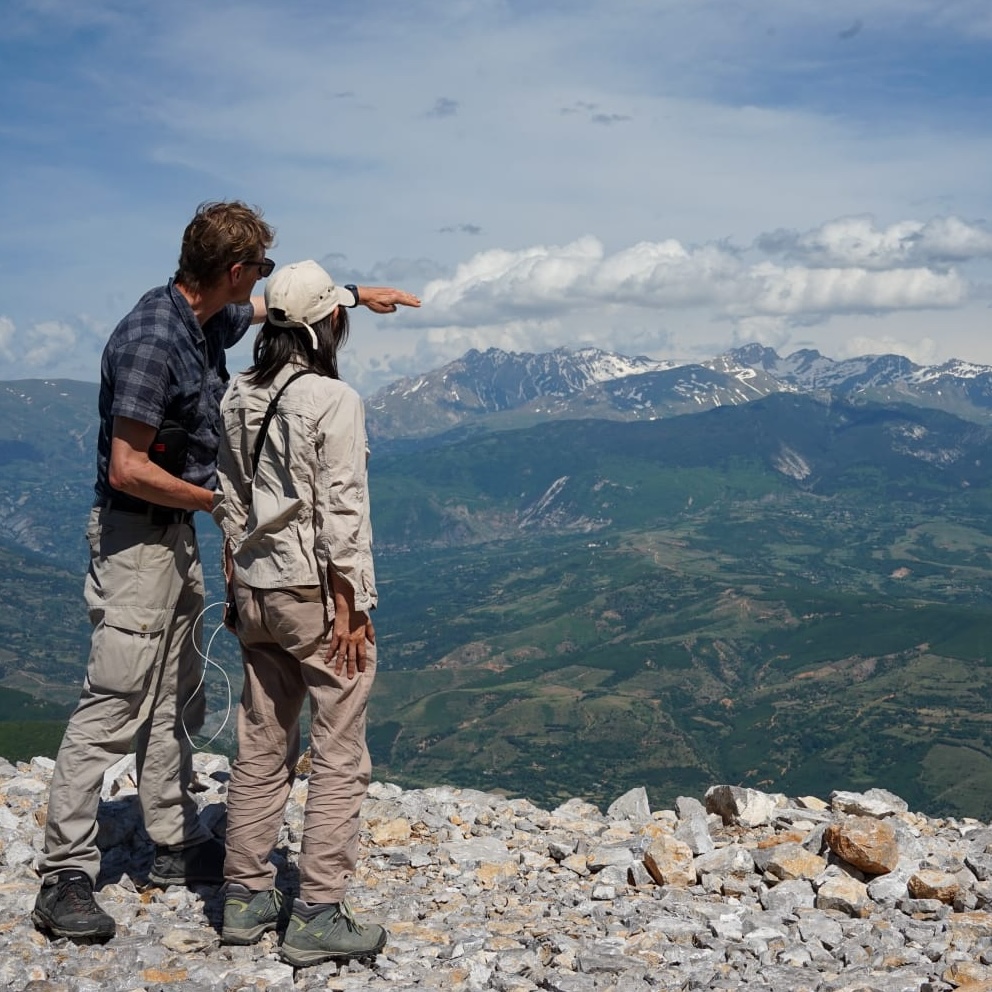
The project is situated in the dominantly SW-vergent Albanian fold-and-thrust belt, where deformation is laterally variable, with contractional and extensional segments reflecting the gradual rollback of the NE-ward subducting Hellenic slab. This transition zone provides a compelling setting for investigating how Neogene to Quaternary deformation, exhumation, and fault activity vary across an orogen that is simultaneously shortening in some sectors and extending in others. The main challenge is to determine the timing and rate of cooling and exhumation across these contrasting domains, particularly in carbonate-rich units where conventional thermochronometers are less effective. To address this, the project applies carbonate thermoluminescence thermochronology and, where possible, fault-gouge dating to reconstruct exhumation and seismic histories.
The aim of the project is to determine how Neogene to Quaternary exhumation differs between contractional and extensional parts of the Albanian Hellenides, and to use carbonate thermoluminescence to quantify cooling ages and exhumation rates. It also aims to date fault activity where possible, especially along major structures such as the Shkodra-Peja Normal Fault, to reconstruct the tectonic and seismic evolution of the region.
The project combines fieldwork, structural mapping, and carbonate thermoluminescence thermochronology. Samples are collected along five transects in contractional and extensional settings, with age-elevation profiles and structural observations used to estimate exhumation rates. Where suitable fault gouges are found, they also will be dated by electron spin resonance and/or optically stimulated luminescence methods to constrain past seismic activity.
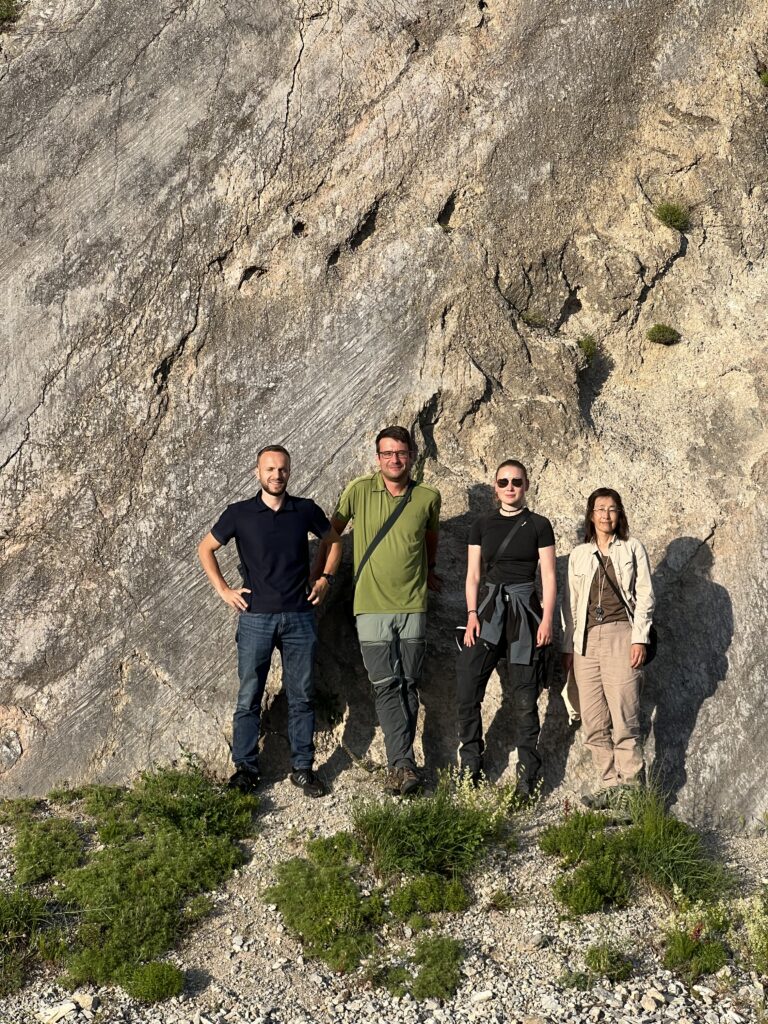
Image: group photo during first sampling campaign in June 2026 in front of Triassic carbonates exposed along a supposedly recently active normal fault scarp in the Korab massif, eastern Albania. From left to right: MSc. Oltion Koleci (PhD student, Polytechnic University Tirana, Faculty of Mining and Geology), Dr. Philipp Balling (Uni Jena), Marah Kieckbusch (BSc student, Uni Jena), Prof. Dr. Sumiko Tsukamoto (LIAG & Uni Tübingen). © Kamil Ustaszewski.
Researchers
-
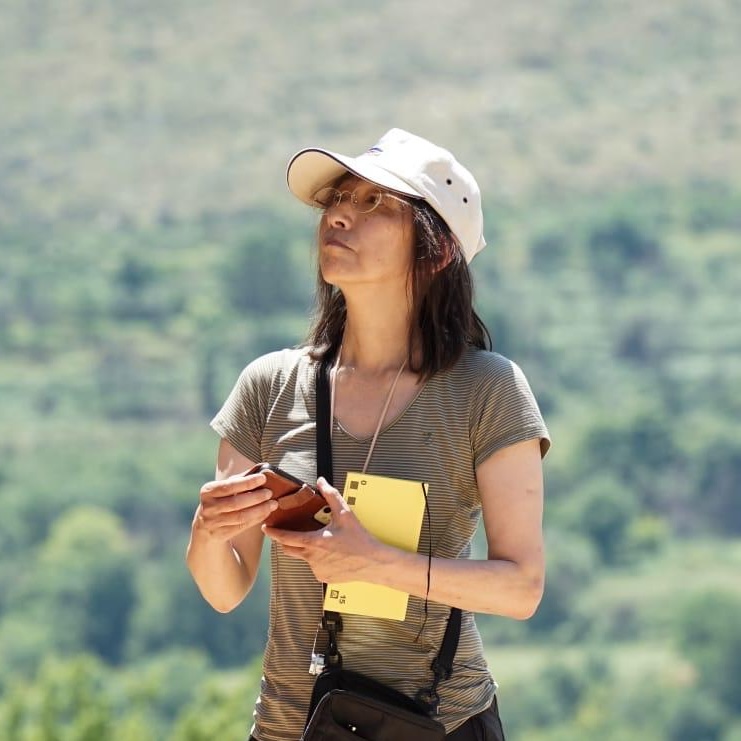 Sumiko TsukamotoPrincipal Investigator
-
 Kamil UstaszewskiPrincipal Investigator
-
 Neda RahimzadehPostDoc